
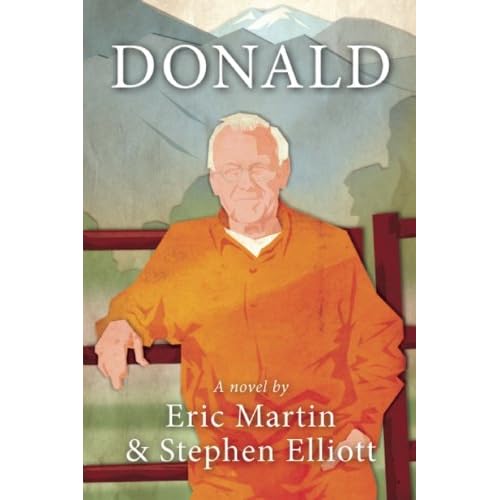
Holy shit.
I didn't know what to expect when I opened the slim envelope containing next release in the McSweeney's Book Club, entitled Donald. The cover is unmistakably identical to the cover of his memoir Known and Unknown, released just two days ago, but I was wondering why McSweeney's would ever publish anything about Donald Rumsfeld. Fair question.
Holy Shit.
What a powerful and relevant social commentary entangled within a tight, gripping story. But we already know the story, in one way or another. That the authors intentionally locate the story in the very near present - he is working on his memoir in the beginning of the novella - turns us back into both ourselves and the world around us; this is certainly not art for art's sake.
And yet, its artistry is well exhibited. The portrayal of this man's psychological break through a well orchestrated series of torture is strikingly real. We never leave Donald's point of view throughout, always as equally in the lurch as he; ourselves willfully abducted by the mystery that, again, we probably already know...most likely.
In a weird way, I don't think this book necessarily deals Donald any serious blows. The title itself - invoking the aura of another Donald who merely precedes with a 'the' - romanticizes its main character. Donald. The text portrays a man who we might have actually come to admire and like in another context; in another story less real and completely fucked up.
'History suggests that we might be luckier to be vanquished from without than left to our own decline. It's the choice between being shot high off the rampart or hanging from the shower curtain' (72). In a way, this is an argument that cannot be won; you either succeed or someone else will. There are either things known or unknown. No middle way; there is no Nagarjuna. Words that couldn't have been spoken better than by the real man himself.
But I have an even better one for you. I had a conversation very recently with someone who espoused this same intention: 'The price of ruining one innocent life is steep but it is less than the price of thousands of lives destroyed by lenient misjudgment' (86). What happened to America, land of principles and Ideals; that 'it is better a hundred guilty persons should escape, than that one innocent person should suffer'? Where is that reality? I guess it is here, in this book, and with me, on this blog, and in those who read this book and are simultaneously aghast that this book is 'based closely on non-fiction sources' (111) and humored with its fictions.


No comments:
Post a Comment